Pump Diodes
Electrical input is converted into pump light through diode stacks whose thermal behavior affects source efficiency and service life.
IPG source architecture begins at the pump diode and ends at the delivery fiber. Between those endpoints sit active Yb-doped fiber, Bragg grating resonators, pump combiners, MOPA pulse shaping, thermal control, and monitored interlocks that turn photonics into a repeatable industrial module.
Review Architecture With an Engineer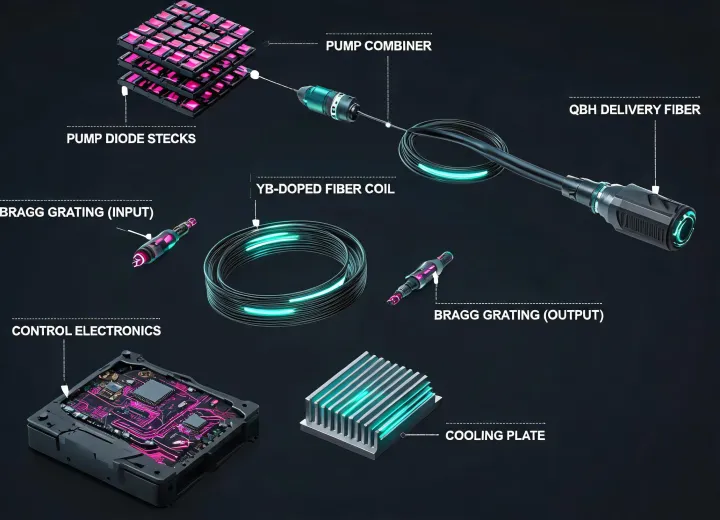
Electrical input is converted into pump light through diode stacks whose thermal behavior affects source efficiency and service life.
Yb-doped fiber provides the gain medium; fiber geometry and splicing quality influence beam quality and output stability.
Grating pairs form the resonator and set wavelength control, reflectivity, and power-handling behavior.
Pump and signal combiners route energy while protecting mode quality and managing heat flow inside the source.
For pulsed sources, master oscillator power amplifier architecture controls pulse width, frequency, and marking behavior.
The final interface connects source physics to the cutting head, scanner, welding optic, or cleaning nozzle used by the machine builder.
Reflective metals and welding optics can return energy toward the source. Protection logic, delivery fiber choice, and process head geometry are reviewed as one system.
Output stability depends on diode temperature, chiller flow, cabinet ventilation, and duty cycle. Acceptance tests should include the real thermal envelope.
Single-mode and multi-mode source choices affect focusability, spot size, cut kerf, weld shape, and scanner marking performance.
Machine builders need predictable enable, emission, fault, analog command, and service signals that can be defended in the safety file.
Beam profile, output stability, and interlock behavior should be captured before the source leaves the integration bench.
Module placement, chiller access, cable bend radius, and diagnostic reach all affect downtime after the machine is shipped.
Share the material set, optics layout, controller platform, enclosure class, and expected acceptance samples. We will turn those constraints into a practical source and beam-delivery recommendation.